Meetings + Events
The power of gathering people
The power of gathering people


Find out how many people will fit in your room or what size room you need for your number of attendees.
Step 1
Choose a Room Layout type:
Step 2
Enter one of the following to determine the other:
Room Size:
sq.ft.
Capacity:
NOTE: This is a starting guideline only. Accuracy for your particular event cannot be guaranteed.
Canada Measures Business Events’ Impact

Skip the layover: WestJet brings back more non-stop Edmonton flights to Montréal and Ottawa
Freeman Expositions Ltd. Canada Announcement
Diversified Canada Acquires MDBriefCase Group,
SITE research highlights incentive travel’s role in connecting the global direct selling community
More personal experiences, purposeful choices and lasting impact are shaping the future of business events. We asked the pros to weigh in on what will be hot and topical in the coming year.
By Laura Bickle 
In 2027, successful event AV will be less about having the newest equipment and more about using it strategically to support the event’s goals, audience and atmosphere, says Melissa Deslauriers, director of client engagement at CCR Solutions Inc. in Toronto.
Breaking down the silos
One of the most important shifts will be breaking down silos between planners, AV teams, designers, speakers and other suppliers. Sharing information—from the event’s objectives and audience to its content and presenters—helps determine which technology, staging and room design will create the greatest impact.
When less technology is more
With five generations now in the workforce, says Deslauriers, planners must also design experiences that resonate with different preferences and comfort levels. “This doesn’t necessarily mean more technology; it means a better understanding of what technology can do to support the experience—and sometimes that means less is more.”
At an architecturally striking off-site venue, for example, discreet battery-powered uplighting, low-profile speakers and carefully controlled background music may be all that is needed. The technician’s role will also become increasingly important. Beyond technical expertise, AV professionals must be proactive, adaptable and customer-focussed.
Making the technology count
Clients will continue to request proposals more quickly as leaner teams manage heavier workloads, says Deslauriers. They will also ask about the latest technology, but “the best tech in the room won’t enhance the experience if you don’t use it correctly.” A giant LED wall, for instance, will fall flat if the content has not been designed specifically for it.
Trust takes centre stage
Smaller, local events, restrained elegance and sustainability will continue to gain ground as budgets remain under pressure. But the defining trend may be trust, says Deslauriers. “It’s not just the attendee experience; it’s the event team experience that is important.” After all, she adds, “technology can be sourced and found; great teams make it happen.”
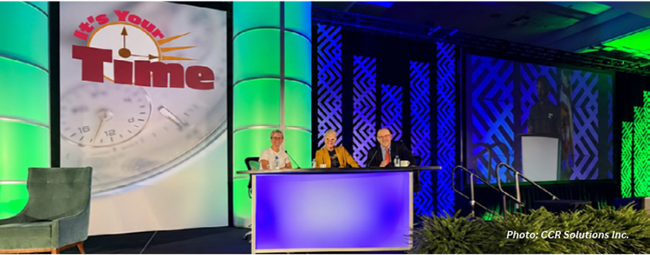
“If the event is a business outlook and you’ve just come off a successful year with even bigger things on the horizon, I would tend to stay away from dark colours,” says Deslauriers. Lighter backdrops, colour and greenery can reinforce a sense of optimism. Similarly, dynamic speakers may benefit from runways, extended stages or horseshoe seating that allows them to move among the audience. Corporate-coloured staging, carpeting and stairs can further strengthen the brand.
The new year’s aesthetic is expressive, layered and rich in texture. Première Vision, an international trade-show organizer and trend resource for the fashion and textile industries, points to renewed maximalism in its spring/summer forecast, with bold patterns, ribbons, fringe and decorative embellishment, alongside glossy finishes and pearlescent satins. Meanwhile, Heimtextil, an international trade fair for home and contract textiles organized by Messe Frankfurt, emphasizes natural fibres, tactile surfaces and materials whose patina and imperfections add character in its 2027/28 forecast. For event decor, these directions suggest patterned linens, sculptural installations and shimmering accents balanced with woven upholstery, wood and handmade ceramics—creating spaces with both visual impact and inviting warmth.
In 2027, event design will be shaped by three interconnected priorities: people, place and purpose. Together, they reflect a shift away from rigid agendas and standardized formats toward more flexible, distinctive and intentional experiences.
People: Designing around the attendee
Attendees are increasingly selective about where they spend their time, making it essential to design around the person—not simply the program. Hub-and-spoke environments, featuring central gathering areas surrounded by smaller stages, education stations, kiosks and interactive activations, will give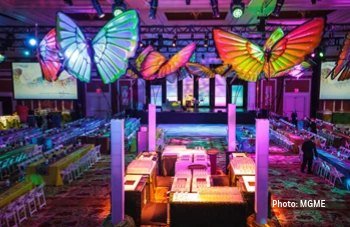 attendees more control over how they participate.
“Clients are thinking much more intentionally about the attendee experience,” says Shelley Milne, client development director, Canada, at MGME, a global MICE agency specializing in meetings, incentives, conferences and events, headquartered in Surrey, BC. “They want people participating, connecting and choosing how they engage—not just being present, but being part of the experience.”
AI will help personalize attendee journeys, but technology should support rather than dominate the experience. The strongest programs will use it to recommend relevant content, streamline planning and uncover insights while keeping human connection at the centre.
Place: Looking beyond downtown
Location will also become a more integral part of event design. Beyond traditional downtown venues, planners are exploring Canadian resorts, rural communities, historic waterfront towns and agriculturally rooted destinations. These settings can bring local culture, character and authenticity into the program while keeping event spending closer to home. The focus is not simply on finding the next “hot” destination, but on assessing its total value, including accessibility, community impact and sense of place.
Purpose: Making every choice count
Purpose will influence decisions around budgets, suppliers and sustainability. With costs rising faster than budgets, every design element will need to earn its place. “Sustainability is becoming less about checking a box and more about making thoughtful decisions throughout the planning process,” says MaryBeth Reeves, director of sourcing and sustainability, MGME. “The goal is to make smarter choices that reduce waste while still supporting the experience.”
Clients will also expect their partners to simplify complexity and provide strategic guidance. As Carvie Gillikin, president and CEO of MGME, explains, “Technology can help us get there faster, but the value comes from how we turn information into insight and action.”
In 2027, successful event design will not be defined by scale or spectacle, but by relevance, authenticity and measurable value.
“From coast to coast, planners are looking inward,” says Milne. They’re choosing Canadian destinations that deliver memorable experiences while supporting our own meetings and events industry, communities and economy.”
In 2027, event decor will move beyond simply making a room look attractive. Furniture, colour and texture will become integral to the event concept, helping shape how attendees experience the space and connect with one another, says Evan Aranoff, vice-president of Luxe Modern Rentals Toronto.
A richer, more tactile look
Warm, tactile materials such as bouclé and brushed brass are replacing the stark white furnishings and acrylic accents that have dominated recent years. At the same time, richer, more saturated colours—including deep emerald, burgundy and sapphire blue—are emerging as a counterpoint to muted neutral palettes.
The result is a warmer, more layered aesthetic that feels curated rather than uniform. Matching furniture collections and long rows of identical seating are giving way to eclectic combinations, mixed-height seating and intimate lounge vignettes. These groupings can establish different moods within the same venue while making networking feel more natural.
Flexibility built in
Flexibility will be another priority. Modular lounge arrangements that can be reconfigured during an event allow a space to evolve from a daytime education environment to a networking reception or evening celebration. Increasingly, planners want that adaptability built into the rental plan rather than relying solely on the room’s existing setup. 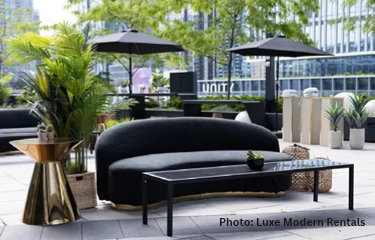
Designed—not just decorated
Attendee expectations are helping drive the change. “Guests increasingly expect events to feel designed, not just decorated—they notice when a space has a distinct point of view,” says Aranoff. Clients are also requesting more customized lounge and networking areas and fewer generic banquet setups. Rather than filling a room with whatever furniture is readily available, planners are considering how each piece contributes to the atmosphere, supports interaction and reflects the event’s identity.
Furniture tells the story
The shift toward less “matchy” decor and more curated mixes signals a broader evolution in the industry. Furniture is no longer being viewed as purely functional. Instead, it is becoming “a storytelling tool” that can communicate a brand, establish a mood and guide how attendees move through a space.
For 2027, the most memorable environments will not necessarily be the most elaborate. They will be the ones in which every colour, texture and furniture choice feels deliberate—and where the design gives attendees both a reason and a place to connect.
“Planners and suppliers need to move earlier in the process, treating furniture and decor as part of the concept from day one rather than a last-minute fill-in,” says Aranoff.
The question shaping corporate gifting in 2027 is less what can we put our logo on and more whatwill someone be glad to receive. Jared Florence, senior executive, promotions and incentives at Incredible 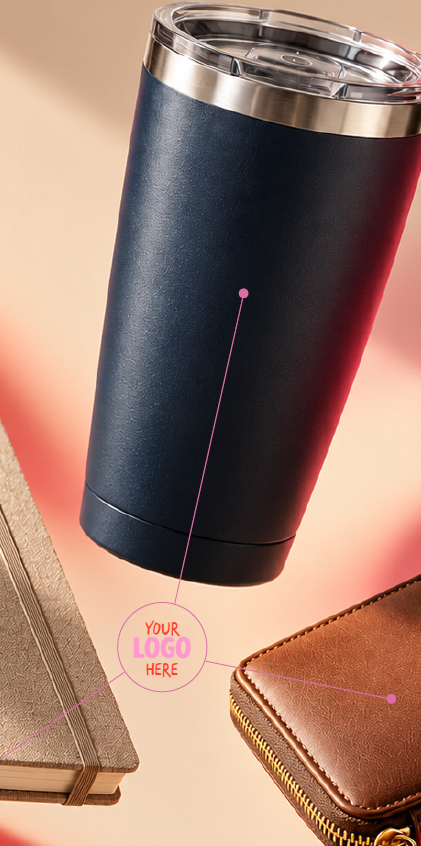 Incentives, sees Canadian companies moving toward gifts that feel useful, personal and made to last. His advice: “Let’s replace disposable swag with products people keep for years.”
Hyper-personalization
A recipient’s name can make a premium tumbler feel more special than a generic gift at the same price. Florence suggests going further: add a favourite saying, an inside joke or even a photo of the recipient’s cat. With some products available in quantities as small as one, individual touches are becoming easier to offer without ordering for an entire group.
Sustainable, useful gifts
Sustainability remains a priority, Florence says, with interest in reusable products and items made from recycled materials, including rPET fabrics and notebooks. Usefulness matters just as much. Tech accessories, travel products and quality drinkware are strong choices for VIP clients, while outdoor gear and lifestyle products suit recipients who will use them beyond the office.
Curated gift kits
Presentation can extend a gift’s life, too. A curated kit packed in a cooler bag or backpack gives recipients another useful item instead of a box they’ll discard.
Wellness-focused employee appreciation
Employee appreciation is increasingly tied to wellness and personal interests. Blankets, gourmet food, premium hoodies and outdoor products can convey a warmer message than standard office merchandise. New hire kits are also becoming a dedicated part of onboarding.
At trade shows, where portability and broad appeal matter, Florence recommends sustainable giveaways, reusable drinkware, tote bags and practical desk accessories. The common thread across every category is simple: choose a gift for the person who will take it home.
Event food is becoming more personal, interactive and globally inspired. For Chef Kishore Rangan, director of culinary at the Vancouver Convention Centre with Sodexo Live!, the shifts shaping 2027 involve both what’s on the plate and how guests experience it.
Smaller plates, more interaction
Traditional buffets are giving way to satellite stations, food pods and smaller dishes that let attendees sample different flavours while circulating.
“We are seeing a move toward smaller-format dishes that create a more personal, curated experience for guests,” says Rangan.
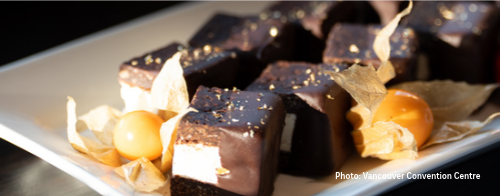
Chefs are becoming more visible, searing fish at stations or finishing dishes in front of guests. Presentation adds to the experience, with varied heights, smaller vessels and custom wooden boards. At networking events, practicality matters: food should be easy to manage while standing, without requiring a knife or somewhere to put down a plate.
Healthier choices, familiar comforts
Clients are requesting more plant-based proteins, whole grains, pulses and greens, alongside fewer heavily processed foods and sugary baked goods. But wholesome eating and comfort food can coexist.
Freshly baked scones and croissants remain breakfast favourites, Rangan notes. The culinary team’s approach is to use fewer processed ingredients and less refined sugar, while preserving the appeal. Popcorn carts, porchetta sandwiches and macaroni and cheese bring an element of familiarity and fun.
Customized menus, global flavours
At the Vancouver Convention Centre, upwards of 70 per cent of menus are customized, says Rangan. A three-day program may feature tailored menus throughout, with several meal and reception requests within each brief. “Cuisine is more global now, rather than concentrated in only a few regions.”
Iranian, Thai, Korean, Indian, Malaysian, Nigerian, Mediterranean and Jamaican dishes are among the cuisines clients are exploring, with authenticity a priority. Seasonal mocktails paired with event themes also reflect growing interest in non-alcoholic options.
Clearer menu descriptions help attendees navigate ingredients, allergies and dietary preferences.
Local sourcing, thoughtful portions
Sustainability continues to influence sourcing and service. Through its partnership with Feed BC, the convention centre is expanding its use of local ingredients, from produce to flour milled in Chilliwack when volume allows.
Smaller plates encourage thoughtful portioning, while food recovery partnerships help direct excess food to organizations that can accept it. Unsold baked goods are offered through Too Good To Go food rescue app.
“Food is increasingly part of what guests see and do at an event, not simply something they are served,” says Rangan.
“Food is increasingly part of what guests see and do at an event, not simply something they are served,” says Rangan. He cites Dine Out Vancouver, where guests moved through the kitchen while chefs cooked in front of them.
Consumer trend forecaster WGSN and Coloro have named Luminous Blue their Colour of the Year, joined by Energy Orange, Pop Pink, Meadowland Green and Clay in their spring/summer palette. For event planners, the palette offers both vibrant hues for playful, expressive spaces and grounded shades that evoke warmth and connection—whether through statement linens, colourful lounge

1. Canada takes centre stage
Distinctive local experiences offer a compelling way to position Canadian meetings and incentives. Indigenous-led activities, culinary encounters, wilderness retreats and connections with local innovators give programs a strong sense of place.
2. Legacy becomes part of the plan
The definition of event success is expanding beyond attendance and room nights. Research partnerships, talent development and community benefits are bringing greater attention to what happens after delegates leave.
3. Attendees shape their experience
A more flexible approach to programming gives participants different ways to learn, connect and recharge. Small-group discussions, hands-on activities and optional excursions make room for individual interests within a shared experience.
4. AI joins the planning team
AI is becoming part of the conversation around planning efficiency and personalization. Its potential lies in supporting tasks such as organizing information and drafting communications, with planners providing judgment, creativity and relationship expertise.
5. Sustainability starts earlier
Environmental considerations reach across the event, from destination selection and transportation to menus, rentals and gifts. Integrating these priorities into the initial brief makes them part of program design and purchasing decisions.
6. Incentives face the measurement question
Demonstrating the business value of incentive travel remains a key challenge. Performance, retention and stronger relationships provide potential measures of success, alongside participants’ assessments of the experience.
7. Career sustainability stays in focus
Compensation, workload and career development remain central questions for the business events industry. The next step is translating those conversations into workplace practices that retain experienced professionals and attract new talent.
Originally published in the Winter 2026 issue of Ignite. Find more trends and inspiration in the digital version of Ignite's 2027 Trend Report here.
other articles in this section
Ask Your Way to Greener Catering
Five Cool Things at…the Destinations International Annual Conference
Tips for the Accidental Meeting Planner
How Destination Vancouver is Building a Social Procurement Strategy
The Dilemma: The Rising Cost of Events
Event Profile: Raising funds and spirits
Green Business = Good Business
Case Study: Testing event restrictions
Case Study: Virtual Awards Show
Case Study: A hybrid event for meeting planners
Case Study: Canadian Event Industry Awards
Case Study: 100-person virtual mentoring event
Event spotlight: ConferenceDirect meets at Caesars Forum Las Vegas
By the Numbers: October 2020 Edition
Grab the Mic, Grow Your Business
Should you give interns a turn?
Back to Business: Insights from the MTCC
Back to Business: Insights from byPeterandPauls Hospitality Group
Back to Business: Insights from Industry Associations
Must-haves for the New Reality
Back to Business: Insights from White Oaks Resort & Spa
Back to Business: Insights from Casa Loma Escape Series
Back to Business: Insights from JW Marriott The Rosseau Muskoka
The new reality for... Speakers
The new reality for... Caterers
The new reality for... Team Building
CanSPEP Connext Conference Kit
How to turn delegates into social media brand ambassadors
The new reality for… CONVENTION CENTRES
